
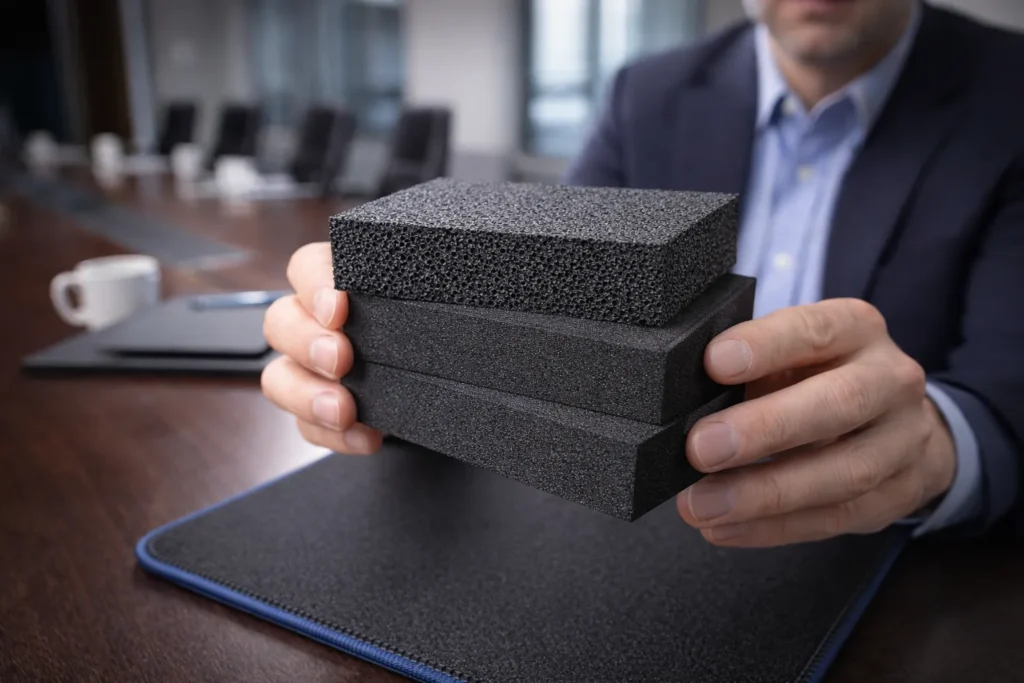
Unmatched Compression Recovery & Resilience
One of Poron foam’s standout qualities is its ability to recover its shape after compression. Unlike typical foams that “sink” or stay flattened over time, Poron’s open-cell microstructure acts like millions of tiny springs, bouncing back after each use. In technical terms, Poron has exceptionally low compression set: it resists breaking down or permanently deforming even under constant pressure. For mouse pads and wrist rests, this means the cushion maintains its thickness and support day after day. For example, Rogers Corporation (the maker of Poron) notes that open-cell polyurethane foams like Poron won’t lose their cushioning properties after multiple uses, whereas closed-cell foams quickly start to “take a set” and flatten out. In practical terms, a Poron-based mouse pad will feel nearly as supportive on year two as it did on day one, whereas a standard PU or EVA foam pad may develop hard spots or thin areas. This spring-like resilience gives premium brands confidence that their products will perform consistently over time, providing end-users with a like-new experience even after extensive use.
Long-Term Durability and Longevity
When premium brands promise quality, material longevity is paramount. Poron foam delivers on long-term durability, far surpassing standard foam materials. Thanks to its high-density urethane composition and engineered cell structure, Poron resists the common failure modes of cheaper foams. It does not crumble, crack, or harden with age as some foams do, and it endures heavy daily use without degrading. A major practical benefit of Poron is its ability to resist permanent compression – it retains its shape and cushioning even after thousands of cycles of pressure. In fact, Poron foam “maintains its strength and integrity for long periods of time when compressed”. This durability directly translates to a longer lifespan for mouse pads and wrist rests. End-users won’t need to replace a Poron-based pad as frequently, reflecting well on a brand’s reliability. Moreover, Poron is chemically stable and “will not become brittle or crack in low temperatures”, and it remains resilient across a wide range of operating conditions. It’s also inherently low-outgassing and non-fogging, meaning it doesn’t emit odors or oils over time – a common issue with lesser foams and rubber bases. This absence of odor and deterioration reinforces the perception of a high-quality, well-engineered product. In short, choosing Poron allows OEMs to offer a long-lasting product: one that can handle years of intense clicking and gliding without losing its supportive feel or falling apart. This level of durability is a key reason top-tier manufacturers invest in Poron for their flagship models.
Superior Comfort and Anti-Fatigue Support
Premium mouse pads aren’t just about precision; they’re about comfort during prolonged use. Poron foam excels in this arena with its unique combination of soft cushioning and high energy absorption. The material is often described as plush yet supportive – when you rest your hand or wrist on a Poron-padded surface, it gently conforms to distribute pressure, but it also provides a subtle rebound that prevents that “sinking” feeling. This balance helps reduce fatigue during long gaming sessions or work hours. In fact, Poron is renowned for its shock-absorbing properties – it can soak up impact and vibrations to an exceptional degree. Rogers Corp. notes that Poron’s open-cell urethane construction gives it one of the highest levels of shock absorption among cushioning materials, since air can move in and out of the cells to dissipate force. For users, this means less strain on joints and tendons: the foam pad absorbs micro-impacts (like rapid mouse movements or constant pressure from typing) that would otherwise transmit to the wrist or hand. Medical ergonomics applications underscore this benefit – Poron is used in high-end running shoe insoles and even prosthetic limb liners to reduce impact on the body, so it brings a similar anti-fatigue effect to a desk environment. Another comfort aspect is temperature and moisture: open-cell foams tend to be more breathable than dense rubber, so a Poron wrist rest may stay cooler and drier (no sweaty palms sticking to the pad). By choosing Poron, brands ensure their mouse pads and wrist rests feel great hour after hour, helping end-users maintain comfort and focus. This level of ergonomic comfort is often a deciding factor for B2B buyers in corporate or medical settings who seek to improve employee wellness and productivity through better accessories.
Refined Surface Stability and Finish
Beyond internal performance, Poron foam contributes to the overall build quality and feel of a premium mouse pad. One notable advantage is its surface stability: a Poron foam base lies flat and uniformly supports the surface layer (whether cloth or hard laminate) without warping or bubbling. The foam’s fine, homogeneous cell structure results in a very even material density, which means when a fabric or micro-textured surface is laminated on top, the result is a flawlessly smooth tracking surface. There are no random soft spots or lumps that could impede mouse glide or cause inconsistent sensor tracking. Moreover, Poron foam often has a naturally grippy, non-slip underside. Pads made with Poron tend to “stick” securely to the desktop — the material’s slight tack and high friction ensure the pad doesn’t slide around during intense use. This is a critical feature for both gamers and professionals, as a slipping base can ruin accuracy. Notably, Poron achieves this grip without the strong rubber odor that many traditional rubber-backed pads have; Poron is a low-odor material with no vulcanized rubber smell at all. It’s also inherently flame-retardant and doesn’t require extra chemical additives to meet safety standards – a subtle quality indicator of a well-engineered product. From a manufacturing perspective, Poron foam’s consistency allows for precise cutting and cleanly finished edges, whether the pad uses stitched borders or not. The edges resist fraying and the foam won’t start disintegrating or flaking, which sometimes happens with lower-grade foams. All these factors contribute to an overall premium fit and finish. When a customer unboxes a high-end mouse pad with a Poron base, they’ll notice the pad feels substantial and lays perfectly flat, exuding quality. For brands, this attention to material detail helps justify premium pricing and leaves a strong first impression of excellence.
Poron vs. Standard Foams (PU, EVA, TPE) – What Sets It Apart
It’s helpful to compare Poron foam with common foam materials that OEMs might consider (or that are found in lower-end products), namely traditional polyurethane (PU) foams, EVA foams, and TPE (thermoplastic elastomer) foams or gels. Each of these has its place, but none match Poron’s all-around performance, especially for premium applications:
- Poron vs. PU Foam (Memory Foam): Standard PU foam, including memory foam, can offer initial softness but tends to fatigue over time. Memory foams slowly rebound and often develop permanent indentations with prolonged use. Poron, on the other hand, is a high-density polyurethane designed for resilience – it springs back quickly (no slow “memory” sink) and resists lasting deformation. Where a memory-foam wrist rest might flatten out after a few months of daily use, a Poron foam rest maintains its full support. Additionally, Poron’s open-cell structure means it won’t trap heat as much, whereas memory foams can run warm. PU foams are cheaper, but in exchange, you get a shorter lifespan and a less consistent feel. For OEMs targeting a premium, long-lasting product, Poron’s compression set resistance and durability clearly outperform generic PU foam.
- Poron vs. EVA Foam: EVA (ethylene-vinyl acetate) is a closed-cell foam commonly used in budget mouse pads and many other products (shoe soles, gym mats) because it’s inexpensive and has a firm, bouncy feel initially. However, EVA foams suffer from compression set significantly – the air-filled cells eventually collapse and do not fully reinflate, causing the material to “take a set” (flatten) relatively quickly under constant pressure. Users of EVA-based pads might notice the pad becoming harder and thinner in frequently pressed areas. In contrast, Poron’s open cells allow air to move in and out freely, acting like springs that return to shape after each use. Poron provides a softer, more cushioning feel than the typically stiffer EVA, and importantly, it maintains that feel over time. EVA also can’t match Poron in shock absorption or vibration damping. Essentially, EVA is chosen for low-cost implementations, whereas Poron is chosen for performance. Brands that upgrade from an EVA rubber base to a Poron base are prioritizing longevity and user comfort over saving a few cents in material cost.
- Poron vs. TPE (Gel) Bases: TPE refers to a class of soft rubbery materials (thermoplastic elastomers) often used in gel wrist rests or ultra-soft pads. Some mouse pads use a squishy silicone or TPE gel base to maximize grip and softness. While gels can be very soft, they often have a slow rebound (similar to memory foam) and can even ooze or become sticky as they age. Poron foam can achieve a similar or greater level of softness without those drawbacks. It provides a lively, responsive cushioning rather than a viscous gel feel. TPE-based pads also tend to be heavy. Poron foam is lightweight yet still offers a stable, non-slip footing like gels do. In terms of durability, Poron likely outlasts most TPE gels, which might break down or harden after extended use. One advantage TPE has is being non-porous (since it’s not foam), so it won’t absorb moisture; however, Poron’s open-cell format in mouse pads is usually enclosed in fabric, mitigating any issues with moisture. In summary, TPE gels deliver on softness, but Poron delivers comparable comfort with better resilience and without the mess or short lifespan that some gels suffer.
Overall, these comparisons show that Poron occupies the top-tier position among cushioning materials for mouse pads. Standard foams might be acceptable for entry-level products, but for OEMs aiming to differentiate with quality, Poron provides a clearly superior foundation – ensuring the end product remains comfortable, supportive, and intact far longer than the alternatives.
Real World Brand Use Cases
The adoption of Poron foam by industry leaders speaks volumes about its benefits. Here are a few examples of how top-tier brands in different sectors leverage Poron in their mouse pads and wrist rests:
- Gaming Gear: Enthusiast and esports-focused brands have been early adopters of Poron foam bases. For instance, Fnatic’s DASH2 MAX gaming mousepad features a 6 mm genuine Poron foam core, explicitly chosen to provide a “thick, soft and balanced rebound” for extra control and comfort. This pad, marketed as one of Fnatic’s most premium offerings, uses Poron to achieve performance that professional gamers demand – the thick cushion allows players to press in for added control without feeling the pad bottom out. Other major gaming brands have similarly turned to Poron for their flagship pads. In fact, popular brands like SteelSeries, Razer, and Logitech have incorporated Poron foam into their high-end mouse pads to enhance durability and feel. For example, Razer’s and Logitech’s pro-level mouse mats (often co-developed with esports athletes) need to maintain consistency under heavy use, which Poron’s resilience supports. Even artisan mouse pad makers (such as Japan’s Artisan brand) built their reputation on Poron bases that give a uniquely consistent glide and long life. In the competitive gaming market, using Poron is a clear signal that a mouse pad is built for top performance and not mere cost-cutting.
- Office & Productivity: In professional office environments and for serious productivity enthusiasts, ergonomic comfort and product lifespan are key. Premium office accessory makers have started using Poron in wrist rests and specialty mouse pads to cater to this need. For example, some high-end keyboard manufacturers have released wrist rests with Poron foam padding to ensure the support doesn’t flatten in a few months as typical memory-foam rests do. The result is sustained ergonomic benefit for users who type or mouse for 8+ hours a day. Corporate buyers (B2B clients outfitting their workforce) appreciate that a Poron-based accessory will maintain its supportive feel and won’t need frequent replacement. We also see Poron foam being used in anti-fatigue desk mats and other ergonomic supports for standing desks, as its shock absorption reduces fatigue in a way cheaper foam mats can’t. While office brands might not always advertise “Poron inside,” the ones that invest in it do so to align with their premium branding – delivering reliable, long-term comfort to customers. It’s not uncommon that an OEM supplier like Darshion will offer Poron as an upgrade option for clients seeking to differentiate an “executive” or “pro” version of a product.
- Medical & Ergonomic Applications: Poron’s credentials in the medical and ergonomics field are well-established, which is influencing its uptake in high-end consumer ergonomics. Medical-grade mouse pads or arm rests (such as those used in healthcare settings or for users with special needs) use Poron for its proven pressure-relief qualities. To illustrate the material’s pedigree: Poron is used in critical health-related cushioning applications like prosthetic limb liners and orthopedic insoles because it reliably absorbs impact and relieves pressure without breaking down. That same quality is highly valued in medical-grade anti-fatigue mats, surgical table pads, or rehab equipment, where maintaining cushioning over time can be a matter of health and safety. Premium ergonomic brands that supply products like therapy wrist supports or specialty mouse pads for injury prevention often specify Poron foam to ensure clinical-level performance. By doing so, they align their products with materials that meet stringent requirements (for example, Poron is non-toxic and maintains performance even after repeated sterilizations or cleanings, which is important in medical settings). For an OEM or brand, leveraging Poron in ergonomic accessories thus not only provides superior comfort but also instills confidence that the product meets a higher standard – one that even medical professionals trust for mitigating fatigue and injury.
In all these cases, the common thread is that Poron elevates the product to a premium tier. Whether it’s competitive gamers noticing their mouse pad feels just as good after a year of tournaments, or an office worker who realizes their wrist rest isn’t going flat like the last one did, the end result is increased satisfaction. These real-world use cases demonstrate why so many premium brands choose Poron when they could have settled for cheaper foam – it tangibly improves the user experience and upholds the brand’s promise of quality.
Poron Aligns with Premium Brand Values
Choosing Poron foam isn’t just an engineering decision; it’s a brand decision. Premium brands are built on values like reliability, superior feel, and long lifespan, and Poron material embodies these values in a very concrete way:
- Reliability (Consistency): A premium product should perform consistently for all customers, whether on day 1 or day 1000. By using Poron, brands ensure that every mouse pad or wrist rest that leaves the factory will deliver reliable support over time. The material’s stability (low compression set, low degradation) means fewer warranty claims or customer complaints about a pad “wearing out.” This reliability protects the brand’s reputation. In the eyes of B2B buyers especially, knowing that the accessory will maintain its specs and comfort for years is a huge plus – it reflects the brand’s commitment to quality assurance. In essence, Poron helps eliminate a common point of failure (flattened pads), allowing the brand to confidently market their product as a long-term investment for the user.
- Premium Feel (Customer Experience): High-end brands differentiate themselves by the feel of their products – that tactile sense of luxury and thoughtful design. Poron contributes directly to a premium feel: it’s often described as “plush but not mushy,” giving users a sense of comfort and support as soon as they touch the product. When a customer rests their hand on a Poron-cushioned wrist rest or notices the dense support under a mouse pad, it creates a subconscious impression of quality. This enhances the overall user experience that the brand is delivering. Additionally, the absence of harsh chemical smells and the refined finish of a Poron-based product (no flaking or unevenness) make the unboxing and daily use feel upscale. Premium brands want every aspect of their product to delight the customer, and the comfort of Poron foam is a key part of that delight that cheaper foam simply cannot replicate.
- Longevity (Sustainability and Value): Premium brands often charge more, and customers are willing to pay more, but in return they expect a longer service life and enduring performance. Poron aligns perfectly here, as it significantly extends the usable life of a pad. A longer lifespan not only means better value for the customer, but it also ties into sustainability values – products that last longer reduce waste, a point many modern brands highlight. From a brand storytelling perspective, being able to say “we chose a material that will make this product last 2× longer than the norm” is powerful. It shows the brand is investing in quality over cost-cutting. Moreover, Poron’s use in demanding environments (from industrial gaskets to aerospace components) is a testament to its durability. That kind of pedigree gives premium brands a narrative of technical excellence and trustworthiness. They can legitimately claim their mouse pad uses “the same class of advanced material found in high-performance athletic gear and even space technology.” Such associations reinforce the brand’s image as cutting-edge and reliable.
In summary, Poron foam is much more than a component – it’s a strategic choice that reinforces a premium brand’s identity. By delivering reliability, comfort, and longevity, it helps ensure that the end product lives up to the promises made in marketing. For OEM sourcing teams and product managers, opting for Poron can be seen as aligning with a no-compromise philosophy: you’re building your product with the best, which in turn signals to your customers that your brand can be trusted for top quality.
Conclusion: Elevate Your Products with Poron – Partner with Darshion
As we’ve explored, Poron material offers a compelling array of advantages for high-end mouse pads and wrist rests – from unmatched resilience and comfort to a tangible boost in perceived quality. It’s clear why so many premium brands choose to incorporate Poron foam: it helps create products that stand out in performance and stand up over time, delighting both users and B2B buyers.
If you are a product manager, OEM buyer, or brand leader looking to elevate your next mouse pad or ergonomic accessory with Poron foam, it’s crucial to work with a manufacturer that understands this material’s nuances. Darshion, as an experienced OEM supplier in this space, can help translate Poron’s technical benefits into a finished product that aligns with your brand’s vision. We invite you to reach out to our team for guidance on design, material sourcing, and production of OEM-quality Poron-enhanced mouse pads and related products. With expert support, you can leverage Poron to deliver an exceptional user experience and reinforce your brand’s premium promise. Feel free to contact Darshion for a consultation or quote – let’s collaborate to bring your customers the quality and comfort they deserve.

 German
  English
  Spanish
  Russian
  Polish
  Dutch
Dutch  Portuguese
  Turkish
  French